How to play Animalia
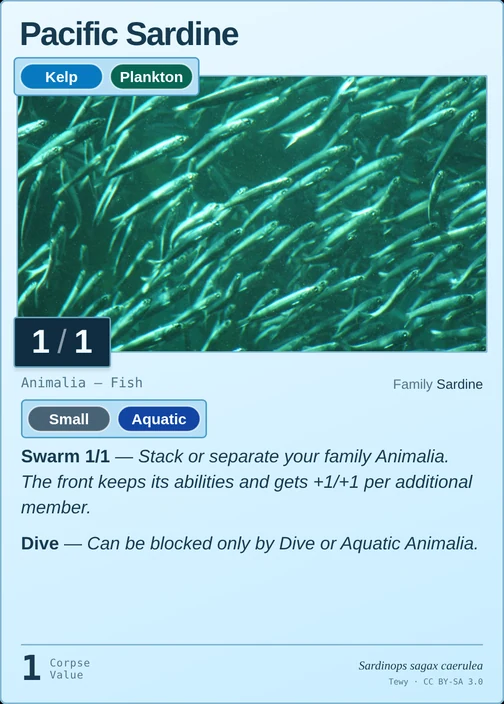
Reading a card
- Costs.
*What you pay to play the card. Exhaust matching Resources for the turn; consume your own Animalia to pay Diet requirements. Consumed cards go to discard and give no points. Pacific Sardine costs one Kelp Resource and one Plankton meal. - Typing / Yield. The animal's gameplay types, and what it supplies when consumed to invoke another card. This Sardine yields Small and Aquatic. Read these symbols, rather than guessing from its picture.
- Attack / Defense. Only Animalia have combat stats. This 1/1 deals 1 damage and dies at 1 marked damage. Other card types have no combat stats. See Fights.
- Explanation. The card's abilities and how to use them. Follow their conditions and costs. Here, Swarm lets family members stack together; Dive restricts blockers.
- Family. A named group used by abilities such as Swarm. Sardine and Pacific Sardine share the Sardine family; Herring does not. Family is separate from Yield.
* Combined costs: a Small + Aquatic requirement needs one Animalia with both types. A Small-only animal and an Aquatic-only animal cannot combine to pay it. Two Small + Aquatic requirements need two different qualifying animals.
Cost notes
- Counted Yield: six Plankton can be paid with three double-Yield Krill, or two double-Yield Krill plus two one-Yield Northern Krill. Consume each meal once; no change.
- New animals: cannot be consumed that turn. Biomass can. Resources can be used immediately.
- Any / Corpse: Any accepts a Resource, eligible Animalia or whole Corpse entry. Corpse costs spend points; spent entries lose their entire value.
Baby animals
A Baby has no size Yield: it cannot pay a Small or Large meal. It may still have explicit Bird or Aquatic Yield. Babies can block, but cannot attack or join a Swarm.
After its normal food wait, consume one Baby as the whole cost to invoke an Animalia of the same species. You need the actual Animalia card in your hand or another zone you are allowed to invoke from. No extra Resource or meal payment is needed. Shared family alone does not match: a Chick made from a selected Gentoo parent can invoke Gentoo, not any Penguin.
The current food labels are Plankton, Insect, Baby, Small, Giant, Large, Huge, Aquatic, Bird, Paragon and Winged. Paragon is the current name for Apex, and Giant for Titan. Fly does not automatically provide Winged or Bird.
Deep Sea: Animalia without Aquatic Yield or Dive get −1/−1, to a minimum of 0/1. Fly and Burrow are disabled for all Animalia on both sides, including protected bodies and granted keywords, making previously evasive Forest attackers blockable by ordinary defenders. Dive, Hunt, Ambush, Baby and all food Yield remain unchanged. Plankton stays base 0/1 with no Plankton bonus; Krill merely yields Plankton, so its unmodified 1/1 becomes 0/1. Camera’s food-only copies stay 0/0. Removing Deep Sea removes its penalty and restores still-applicable Fly and Burrow grants without healing wounds, readying Animalia or refreshing allowances.
Winning Conditions
Reach 40 Corpse Value on your research pile
Your research pile, called the Corpse Pile in the demo, holds the Animalia you collect and your Corpse trophy tokens. You collect them through:
- Unblocked attacks: reveal one opposing Zoo card per damage. Capture the revealed Animalia at printed Corpse Value; other cards go to discard.
- Hunt: this keyword lets your animal attack an opposing Animalia directly instead of its Zoo. Both animals fight back. During a declared Hunt, each player collects the opposing animals killed in its fights, including the hunter and any Ambushers. Having Hunt does not make an ordinary Zoo attack a scoring Hunt.
- Kill: an effect explicitly saying Kill removes an opposing Animalia and collects it into your pile. No damage or fight is needed. Destroy removes an animal without collecting it.
- Trophies: Fungi can create them for your pile. A collected animal token disappears and becomes a trophy worth its Corpse Value; collect an actual animal card directly, without also making a duplicate trophy.
Add the Corpse Values of everything currently in your pile. Reach 40 to win. Animal cards show their printed value at the bottom. Consuming food and ordinary blocked-fight deaths give no points; spending a Corpse removes its value from your score.
Hunt and Kill normally collect at the victim's current Corpse Value; follow any different value stated by the effect.
Empty your opponent's Zoo
The Zoo is the draw deck. Unblocked attacks remove one card per damage dealt, and Ravage effects remove the number they specify. Drawing also uses up the Zoo. You win when the opponent's Zoo is empty after an action and its effects finish.
Finish your research before your opponent
Your Alien research stack has four stages: three shuffled, face-up Alien cards followed by the final victory marker. During Main, sacrifice an eligible original Animalia with Paragon Yield and pay any other costs to use the first unused Alien. Continue in order. After all three are used, offer another Paragon to activate the final marker and win. Tokens cannot supply Paragon.
Make them surrender
A player can forfeit at any time. The opponent wins immediately.
"If you can beat them, ragebait them." — Dr. Grown
"Please don't." — Dr. Alia Rosemare
Turn order
- Refresh: resolve start effects; ready your Resources and Animalia.
- Draw: draw two. The first player draws one and cannot attack or Hunt on their first turn.
- Main: play up to one Resource; invoke cards, use abilities and arrange Swarms.
- Combat: select Go to Hunt; attack one animal at a time. No return to Main.
- End: resolve end effects, clear surviving animals' marked damage and pass the turn.
New animals can fight immediately. Exhausted animals cannot attack or voluntarily defend. An animal normally attacks once on its turn and defends once per player turn.
How to start and half-mulligan
Choose decks and the first player. Shuffle each 70-card Zoo and draw seven. Shuffle the three Aliens separately, reveal their order, and place the final marker last. Begin at zero Corpse Value.
Half-mulligan: once, keep the opening cards you want, put the others on the Zoo's bottom, draw the same number of replacements, then shuffle the Zoo. In the demo, click unwanted cards to mark Redraw, then confirm.
Fights
- Blocked attack: both sides deal damage simultaneously. Damage reaching Defense kills; excess does not hit the Zoo. For example, a 3/4 fighting a 2/3 kills the blocker and survives with 2 damage. Ordinary blocked deaths score nothing.
- Group defense: defenders add their Attack; the attacker divides its one Attack total among them. Each uses its own Defense.
- Unblocked attack: reveal that many Zoo cards. Capture Animalia at printed Corpse Value; discard other cards.
- Declared Hunt: attack an animal directly. Both sides collect opposing animals killed in those fights, including Ambushers and the hunter.